Context
What the model needs right now to act on the task at hand.

AI Product Operating System
The operating layer where a product keeps its knowledge, decisions, and work state, so any agent wakes up knowing where things are. Swap the model. The product stays the product. Every decision stays owned, approved, and auditable.
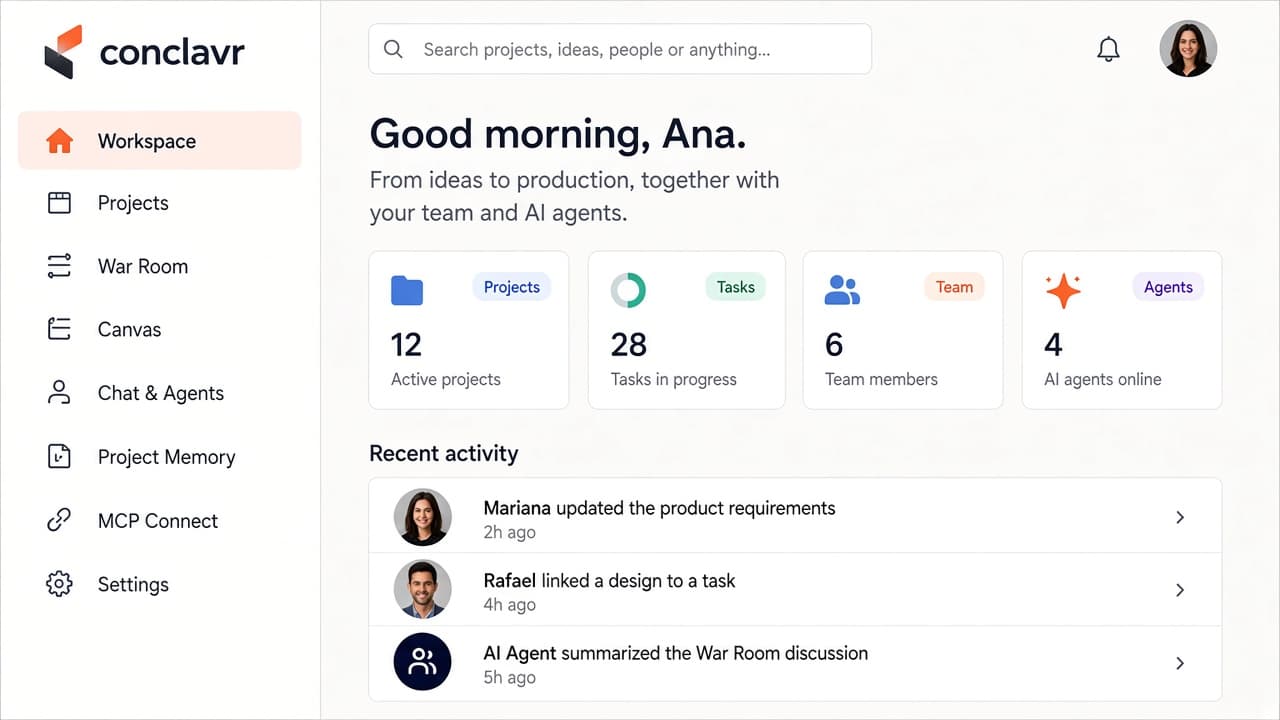
The fracture
Requirements in Notion. Tasks in Jira. Designs in Figma. Code in GitHub. Decisions lost in Slack.
Swap models and every agent starts from zero. Context, decisions, and state reset with the vendor.
Conclavr keeps memory, knowledge, and state outside the model: permanent product infrastructure no model owns.
Manifesto
Not another editor.
Not another chat.
Not another IDE.
Not tied to one model.
The place they converge.
Humans decide. Agents inform. The model stays replaceable.

The layer
Context
What the model needs right now to act on the task at hand.
Memory
What may matter later. Decisions, rationale, and history that persist.
Knowledge
The current truth of the product. Active strategy, architecture, rules.
State
Where the work is now, per epic, story, and agent.
One Context and Memory Engine behind all four: remember, retrieve, reconcile, evolve, compose.
The system
Ownership
Every artifact and every decision has a human accountable. Agents inform, they do not take the seat.
Spec-led
Requirements, decisions, and design live as connected artifacts, not fragments buried in threads.
Governance
Approvals, ownership, versioned decisions, and agent actions stay on the record: who decided, when, and why.
Product
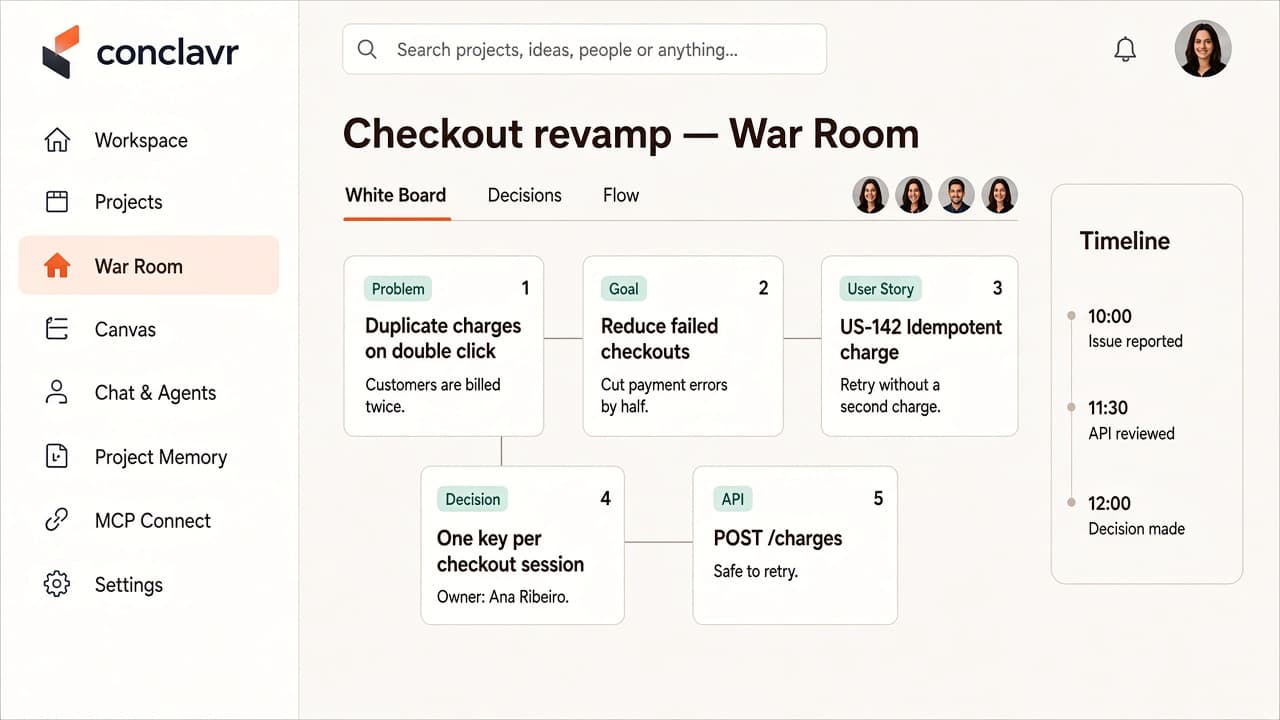
Everything stays on the canvas and in the timeline.
Canvas
PRDs, stories, and specs sit on White Board, Decisions, and Flow, tied to the product graph, not a screenshot buried in Slack.
Memory, State & Context
Agents read project memory, knowledge, and work state. MCP composes the minimal context each task needs, so developers get the story, acceptance criteria, and context inside Cursor, Claude Code, and Windsurf, ready to build. Change the model, keep the continuity.
View the MCP network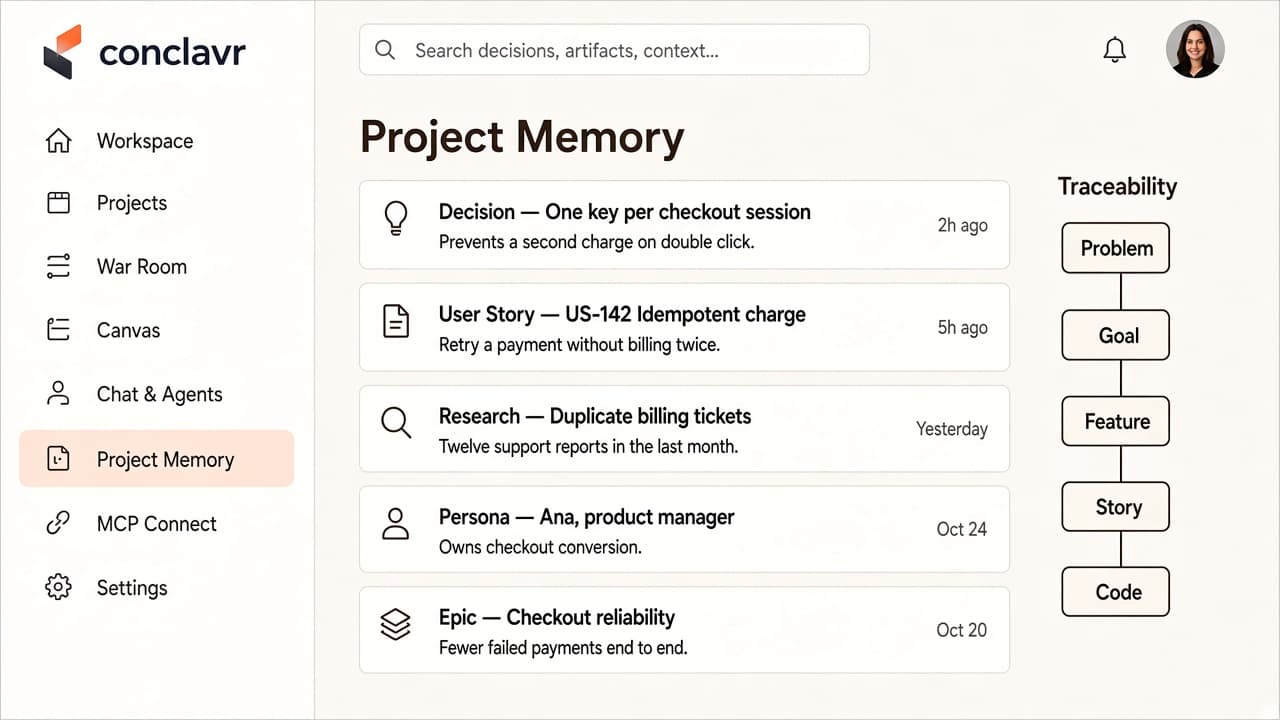
MCP network
Conclavr sits at the center of the work graph. Developers, agents, and editors pull stories, decisions, artifacts, and memory over MCP, without another silo of truth.
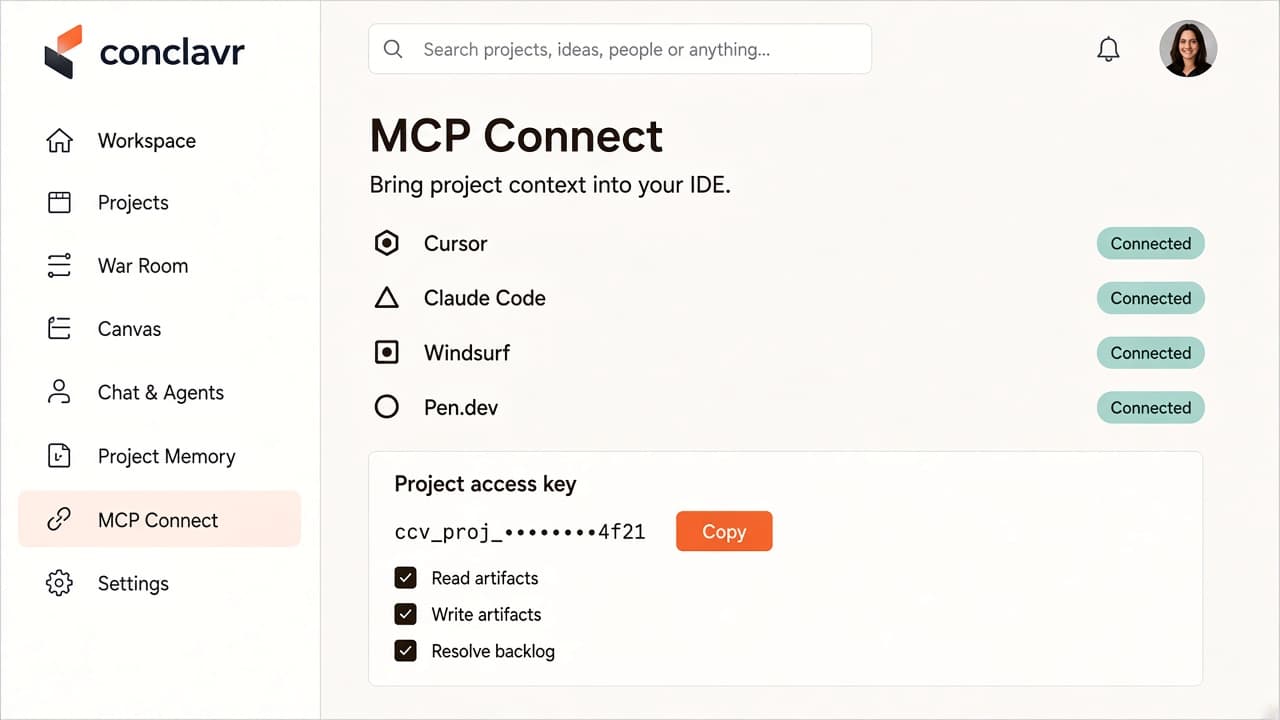
Developers pull stories, specs, and acceptance criteria into Claude Code, Cursor, Windsurf, and Pen.dev, from the same War Room memory.
Figma, Jira, GitHub, and Linear stay in orbit. Conclavr does not replace them.
GPT, Claude, or Gemini plug in over MCP. The product graph is the asset, not the model.
Flow
Clients or business units. Roles that match how you ship.
A persistent session for discovery, delivery, or decisions.
Artifacts and agents on the same graph.
Developers receive specs, stories, and acceptance criteria in the IDE. Export, connect MCP, keep the backlog aligned.
Governance
For POs, PMs, and stakeholders who answer for what ships. Every decision stays owned, approved, and traceable.
Every decision has a named owner, a timestamp, and a rationale. Delegate a call to a PM or stakeholder and get it answered in-thread.
Artifacts move Draft to Review to Approved, with who approved and why. Agents propose, humans approve.
Every action is an event on the Timeline. Nothing relevant lives only in a chat.
Every change keeps a diff, author, reason, and impact. Trace any artifact back to the decision behind it.
In session

Bring ownership into the War Room. Place the artifacts. Connect any model. The session, and the memory, stay.
Enter the War Room